A product line, not a module
Owners Associations, run like institutional portfolios.
Most platforms stop at the unit. The register, the levy, the reserve fund, the resolution nobody can find two years later — Terraa runs that layer as first-class.
35
Dedicated database tables
57
REST endpoints
30
Jurisdictions with statutory rules modelled
10
Governance workflow templates
5
Intelligence modules
36
Dedicated tests in CI
The actual product
The association workspace, as an operator sees it.
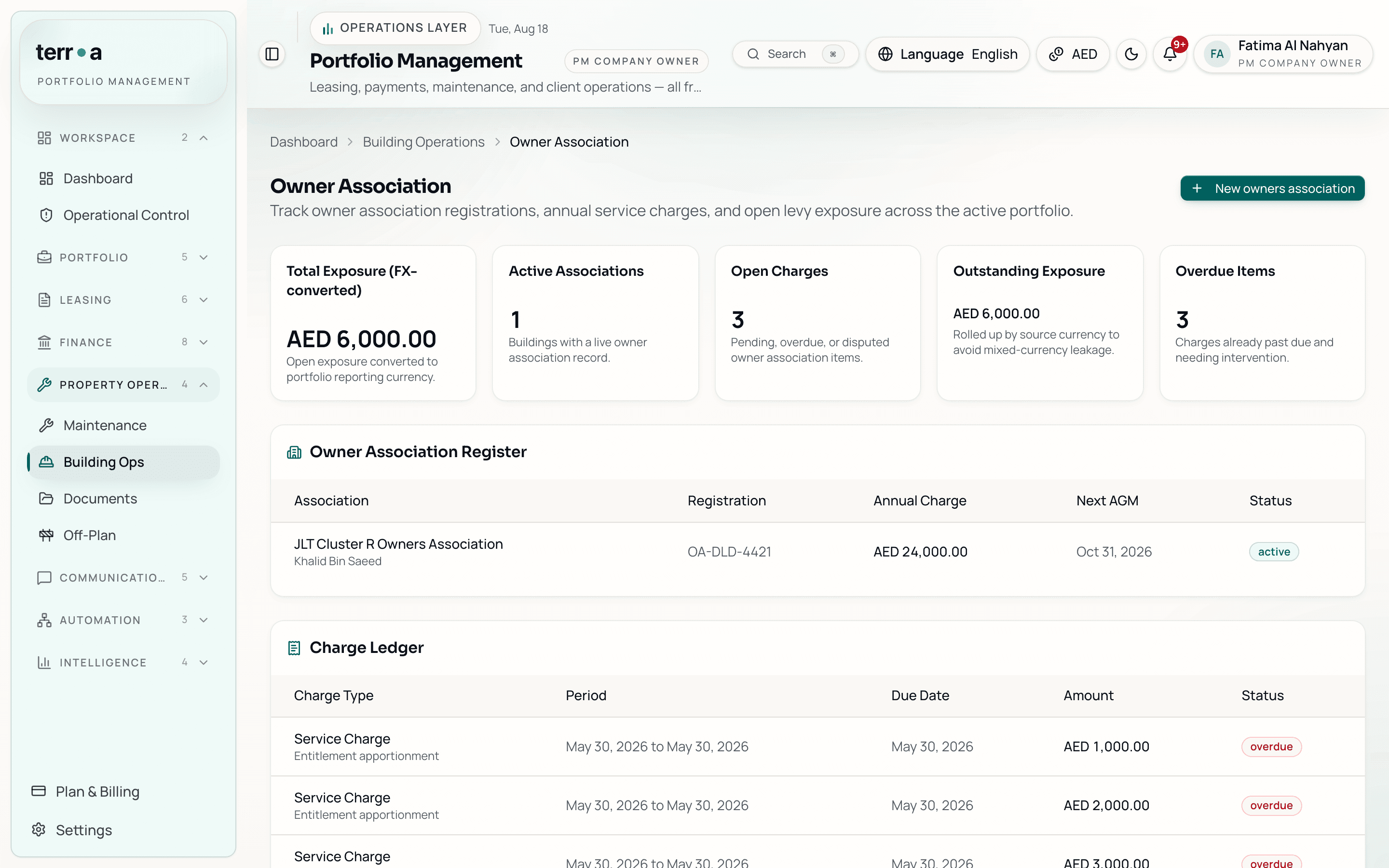
The operating stack
Everything an association actually has to do.
Register, entitlements, and owner ledgers
The owner register with unit entitlements, a charge ledger, and a running ledger per owner. Beneficial ownership is tracked where the jurisdiction requires it, so the question “who actually owns this unit” has an answer that survives an audit.
Budget, levy, and fund accounting
Build a budget, approve it, raise the levy and fan it out by entitlement, floor area or a rule you define. Operating and reserve funds stay separate — a reserve quietly spent on running costs is how associations end up in dispute.
AGM governance that stands up to challenge
Notices, agenda, attendance, proxies, quorum, voting and resolutions — with weights computed from entitlements, not a show of hands. An AI co-pilot transcribes live, so minutes are written by the time the room empties.
Resident operations
Complaints, notices, NOC clearances, visitor passes, parking allocations, amenity bookings, the asset register with maintenance plans, and a confidential whistleblower channel. The day-to-day of a community, handled where the money and the governance already live.
Pooled procurement across associations
Run one tender across several associations at once — a shared RFQ, vendor bidding, scoring, and award. Buying power that a single building cannot reach on its own, which is the clearest financial argument an operator can make to a board.
Intelligence the board can sign off on
Reserve adequacy against the asset replacement schedule, service-charge benchmarking across comparable communities, arrears risk per owner, resident sentiment, and an insurance optimiser that reads claim history against premium.
Jurisdictions
Statutory rules for thirty countries. Two authority integrations. One honest distinction between them.
Every one of Terraa's country configurations carries its own association rules — quorum thresholds, simple and special resolution majorities, reserve-fund minimums, payment terms, late-penalty caps, proxy and electronic-voting permissions, and beneficial-ownership disclosure. That is configuration, and it covers every market the platform supports.
Direct integration with a government platform is a narrower claim, so we make it narrowly: two are built and shipping, three slots are reserved, and every other market runs a supported manual path. Adding an authority is one adapter file.
Built and shipping — 2 authority integrations
Mollak in Dubai and ETMAM in Saudi Arabia, each with a concrete adapter in the codebase.
Slot reserved, adapter not yet written — 3 markets
RERA Bahrain, the Commissioner of Buildings in Malaysia, and CSOS in South Africa are wired into configuration with their statutory rules modelled, awaiting an adapter. We would rather tell you that than imply five live integrations.
Every other market — supported, not stranded
The manual path is a first-class mode with the jurisdiction's own rules applied. Most countries have no association API to integrate with at all — the rules are the substance, and those are modelled everywhere.
Not a bolt-on
The same association data, seen four different ways.
Because OA runs inside the platform rather than beside it, each party sees the slice they are entitled to — with no export, no reconciliation, and no second system to keep in step.
Operations
Run the association — register, finance, governance, resident operations, and the pooled procurement desk.
Owner
An owner sees their own ledger, levies, resolutions, and the fund position behind the charges they are asked to pay.
Resident
The community notice board, amenity bookings, visitor passes, and a route to raise a complaint that gets acknowledged.
Vendor
Open tenders, bid submission, and awarded work orders — with funding source and approval state visible.
For operators and boards